UPS Requirements for CT, MRI, DSA, and Radiotherapy Systems
UPS Requirements for CT, MRI, DSA, and Radiotherapy Systems
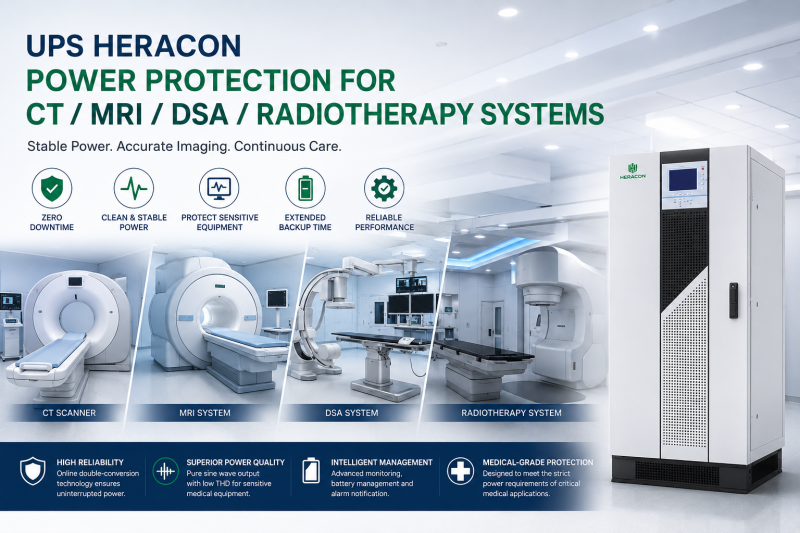
Modern hospitals rely heavily on advanced diagnostic imaging and treatment systems such as CT scanners, MRI systems, DSA equipment, and radiotherapy machines. These medical devices are highly sensitive, extremely expensive, and critically important for patient diagnosis and treatment. Even a brief power interruption or voltage fluctuation can lead to equipment shutdown, image corruption, treatment interruption, or costly system damage.
For this reason, selecting the right UPS Heracon solution for medical imaging applications is not simply about backup power — it is about ensuring stable operation, patient safety, and long-term equipment reliability.
Why Medical Imaging Equipment Requires High-Performance UPS Protection
Unlike ordinary office equipment, medical imaging systems operate with extremely precise electronic components, high-speed processors, cooling systems, and sensitive control circuits. These systems require stable and clean electrical power at all times.
Power disturbances commonly found in hospitals include:
- Voltage sags
- Sudden blackouts
- Frequency instability
- Harmonic distortion
- Electrical noise from other equipment
- Generator transition interruptions
Without proper UPS protection, these issues may cause:
- Imaging errors
- System reboot
- Data loss
- Hardware damage
- Interrupted patient examinations
- Downtime for critical departments
Because CT, MRI, DSA, and radiotherapy systems are often used continuously throughout the day, power reliability becomes a major operational requirement.
UPS Requirements for CT Scanner Systems
CT scanners use high-speed rotating X-ray systems and image processing computers that demand continuous and stable electrical power.
A suitable UPS for CT scanner applications should provide:
- Online double-conversion technology
- Zero transfer time
- Pure sine wave output
- Excellent voltage regulation
- High overload capability
CT systems are particularly sensitive during scanning procedures. A sudden power interruption during image acquisition may force the entire scan process to restart, affecting workflow efficiency and patient scheduling.
In many hospitals, UPS Heracon systems are used to protect:
- Control consoles
- Reconstruction servers
- Cooling systems
- Communication interfaces
- PACS connectivity devices
For larger CT systems, scalability and battery expansion are also important considerations.
UPS Requirements for MRI Systems
MRI equipment presents even greater power protection challenges because MRI machines contain superconducting magnets, cryogenic cooling systems, and highly sensitive RF electronics.
MRI systems require:
- Extremely stable voltage
- Low harmonic distortion
- Clean grounding systems
- Continuous cooling support
- High power reliability
Power instability can affect image quality and may even risk magnet quench events in severe situations.
A high-quality UPS for MRI systems should include:
- True online topology
- Isolation capability
- Intelligent monitoring
- Advanced battery management
- Long backup duration for controlled shutdown
UPS Heracon online systems are particularly suitable for MRI environments because they provide continuous pure sine wave output and isolate sensitive medical electronics from unstable utility power.
UPS Protection for DSA Systems
Digital Subtraction Angiography (DSA) systems are widely used in cardiovascular and interventional imaging procedures. During operation, DSA equipment processes high-resolution real-time imaging data and requires extremely stable power conditions.
Even short voltage fluctuations may result in:
- Image artifacts
- System synchronization errors
- Unexpected interruptions during procedures
For interventional procedures, stable power is critical because interruptions can directly affect patient safety.
UPS requirements for DSA systems typically include:
- Fast dynamic response
- High precision voltage stabilization
- Redundant power architecture
- Remote monitoring capability
- Reliable bypass systems
Because DSA rooms often contain multiple integrated systems, the UPS design must also account for:
- Workstations
- Injector systems
- Network equipment
- Image storage servers
- Monitoring devices
UPS Requirements for Radiotherapy Equipment
Radiotherapy systems are among the most power-sensitive medical devices in modern healthcare facilities. Linear accelerators and radiation treatment systems require highly controlled electrical conditions to ensure accurate dose delivery and patient safety.
A power interruption during treatment can:
- Interrupt radiation sessions
- Affect treatment accuracy
- Cause system calibration issues
- Create operational downtime
UPS for radiotherapy systems must therefore provide:
- High reliability
- Precise voltage regulation
- Stable frequency output
- Redundant protection
- Extended backup capability
In many installations, UPS systems are integrated with hospital generator systems to ensure seamless transition during utility outages.
Because radiotherapy equipment operates with extremely high value and critical precision, hospitals often prioritize premium UPS solutions with intelligent diagnostics and long-term serviceability.
Why Online UPS Technology Is Essential for Medical Imaging
For CT, MRI, DSA, and radiotherapy applications, online UPS technology is considered the industry standard.
Unlike line-interactive UPS systems, online UPS continuously regenerates clean AC output power regardless of incoming utility conditions. This eliminates:
- Transfer delays
- Voltage instability
- Electrical noise
- Frequency disturbances
Key advantages of UPS Heracon online systems include:
- Zero transfer time
- Continuous pure sine wave output
- Advanced protection with isolated transformer at inverter output for sensitive electronics
- Intelligent monitoring systems
- Long-term operational stability
These features are particularly important in medical imaging departments where equipment uptime directly impacts hospital productivity and patient care quality.
Choosing the Right UPS Capacity
Medical imaging equipment often has complex power requirements that vary depending on:
- Equipment manufacturer
- Peak load characteristics
- Inrush current
- Cooling requirements
- Runtime expectations
Proper UPS sizing should therefore be performed carefully during system design.
Hospitals should consider:
- Future expansion
- Battery autonomy requirements
- Redundant configurations
- Maintenance accessibility
- Generator compatibility
- Working with experienced UPS specialists is essential to ensure reliable long-term operation.
Conclusion
Medical imaging and radiotherapy systems require highly reliable power protection to maintain stable operation, protect expensive equipment, and ensure patient safety.
A properly designed UPS Heracon solution helps hospitals minimize downtime, prevent imaging interruptions, and maintain continuous operation during unstable power conditions.
As healthcare technology continues to advance, reliable UPS systems will remain a critical part of modern medical infrastructure, especially for CT, MRI, DSA, and radiotherapy applications where power quality directly affects clinical performance and operational reliability.
Related information
- Why Hospitals and Industrial Users Choose UPS Heracon Instead of Low-Cost Chinese UPS Brands
- Why Reliable UPS Systems Are Essential for Medical and Industrial Equipment
- UPS Heracon Solutions for CT Scanner Systems | Siemens, Philips, GE, UIH, Fujifilm & MinFound
- UPS Heracon HEP80-HC
- UPS Heracon for 1.5 Tesla MRI Systems | Power Protection for Helium and Helium-Free MRI with Chiller Considerations
- UPS HERACON HEP100-6P
